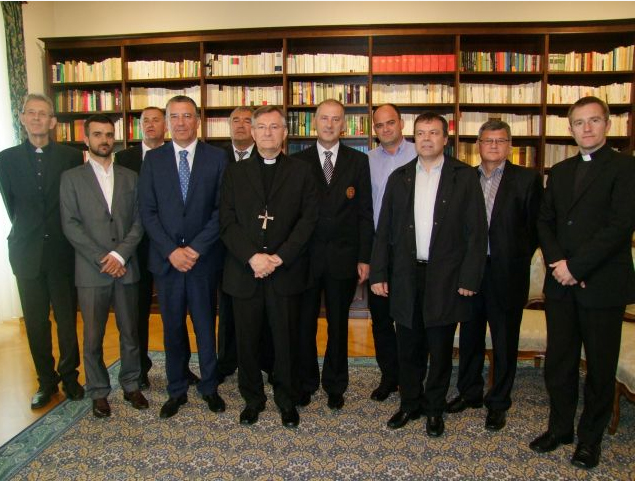
On Tuesday 17th July, Marin Barišić, Split-Makarska Archbishop, received a delegation of the Alka Knights Society at the Archbishop’s Ordinariate in Split.
On Tuesday 17th July, Split-Makarska Archbishop Marin Barišić received at the Archbishop’s Ordinariate in Split a delegation of the Alka Knights Society headed by President Dr. Stipe Jukić, Secretary MD. Ivan Nasić and President of the Court of Honour Andrija Filipović Grčić. Thanking the Archbishop for his kindness and willingness to give support to the Alka festivities, the AKS President presented the course of preparations for this year’s 297th Alka which is going to be held on 5th August. Although Alka, year after year, is becoming ever more recognizable and is bringing together distinguished guests, it was discussed how to improve it even better to make it interesting for tourists, how to point out its significance in the Cetina region throughout the year. In this regard and also to mark the Alka 300th anniversary (1715-2015), some projects have been started such as the Alka Museum, forging gold and silver coins, scientific symposium which will be organized in 2014, and Proceedings which will be issued in 2015 on the very 300th anniversary. The Museum is expected to be of great importance, to revive the town Sinj which now has about 5000 unemployed. By its attractions it is going to appeal to numerous guests and tourists, and to the local people too that will get to know the national, cultural and religious identity of the Cetina region. “Alka is tied with umbilical cord to Christian milieu and Christian values. If Alka had been just a game, it would have been replaced by another game. But, since it is related to the devotion to Jesus Christ and the Blessed Virgin Mary, it is going to last!”, it was stressed at the meeting.
Since the Alka is an introduction to the celebration of the Assumption, the Archbishop emphasized that it was of historical, cultural and religious significance. “Every generation receives and accepts from their predecessors, then incorporates its own wealth and leaves it to new generations. Therefore, Alka is not for someone else, but it is primarily for those who are growing up with it”, said the Archbishop. He stressed that the richness of Croatian culture had to be preserved, but it also had to be made visible, and concluded that the people who did not care about their cultural, national and religious heritage, but rather built shopping centres and hotels, was poor people. Alka is a traditional knightly competition of the alkars of Sinj which commemorates the victory of the Cetina region people over the Turks on 15th August 1715. It is a picturesque competition representing a deft blend of riding a horse at full gallop and targeting at an alka, an iron ring hanging on a rope at a height of 332cm, with a spear 295cm long. Alka takes place in three races: on the first day the Bara is run, on the second the Čoja, and on the third the Alka. The Bara and Čoja winners as well as the Alka winner the champion receive cash prizes and commemorative plaques. From this year on, on the very day of Alka, there will be “The Evening of Winner the Champion” prepared, at which all distinguished guests of political, social and cultural life will be invited. This event is deeply rooted in tradition. It often happens that Alka is embroiled in political intrigues, but it must not happen that these intrigues displace its true meaning, stressed the Archbishop Barišić, and confirmed that he would like, as every year, to participate in the ceremonies of 297th Alka of Sinj. The meeting finished with the exchange of presents and pleasant talks.
Silvana Burilović